
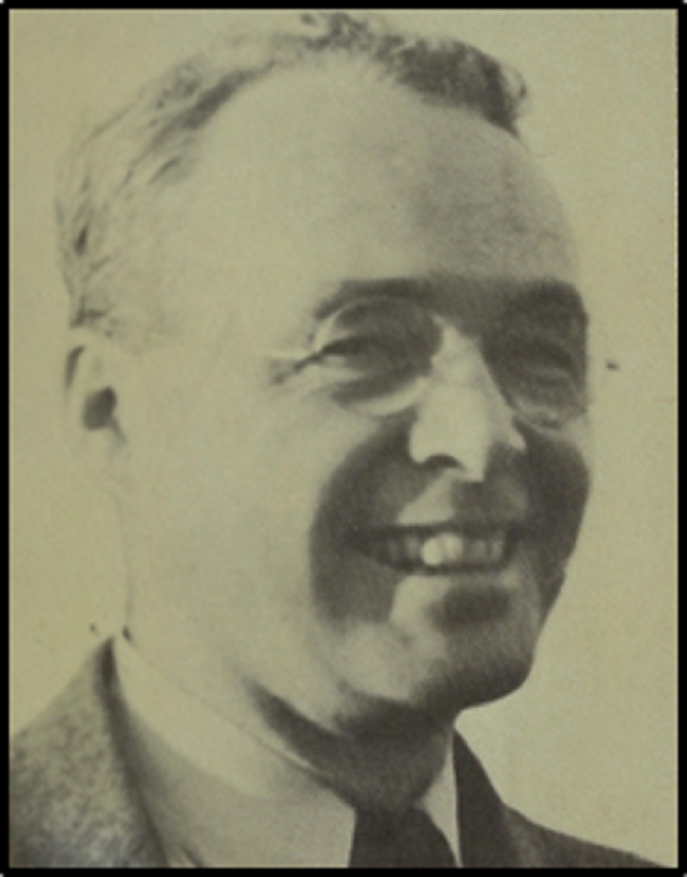
Thomas Kelly
1893-1941
Mentor of the Center
Learning to Respond to the Light Within
I met the man destined to exercise such a great impact on my life, Thomas Kelly, in the summer of 1969—met him, I should say, through his writings, though I felt like I was meeting the man himself.
Preparing for a summer working on the same farm in Germany where I had worked two years earlier, my father’s friend and our neighbor, youth leader in our church, and spiritual mentor to me for the previous few years, Bill Ellis, loaned me Kelly’s small book A Testament of Devotion.
Deep within us all there is an amazing inner sanctuary of the soul, a holy place, a Divine Center, a speaking Voice, to which we may continuously return. Eternity is at our hearts, pressing upon our time-torn lives, warming us with intimations of an astounding destiny, calling us home unto Itself. Yielding to these persuasions, gladly committing ourselves in body and soul, utterly and completely, to the Light Within, is the beginning of true life. It is a dynamic center, a creative Life that presses to birth within us. It is a Light Within which illuminates the face of God and casts new shadows and new glories upon the face of men. —Thomas Kelly, A Testament of Devotion, “The Light Within”
Bill had tried to interest me in the book a year before. I had borrowed it and tried to read it. Yet I found it dry and uninteresting and eventually I returned the book to Bill. I simply wasn’t ready.
Before leaving for Germany in June of ‘69, something prompted me to ask to borrow it again. Thus it was that A Testament of Devotion, packed away in a huge suitcase I could hardly lift, accompanied me to Germany with my friends Jim Douglas and Chuck Grytness. I began reading the book after my arrival at the farm of my friends in northern West Germany. Gradually the lights went on. Kelly’s words pierced me to the depths.
Never has a book exercised such an impact on my life as did Kelly’s “testament” over the course of the next two months. The soil must have been fertile and ready to receive Kelly’s vision of what life with God can be. His entire spiritual outlook sent roots deep into my being in more directions than I am probably aware of even now. I have not been the same since. Two copies of the Testament still sit beside me as I write at this moment—one, recently discovered, in German.
The vision articulated by Thomas Kelly became part of my consciousness as if it had been physically grafted into me. His vision is as intrinsic to my being as are the organs and limbs of my body. His illumination of the life of the Spirit, summarized in the quote above with which his book begins, truly represents the “mainspring” of my inner spiritual clock. If through the years George MacDonald’s influence in my life later became perhaps more pervasive, it was nevertheless Kelly—two years before I had even heard of George MacDonald—who wound the springs of my spiritual life and set the pendulum in motion.
Looking back and again reading Kelly’s descriptions of the first attempts to live in constant awareness of the presence of God half a century after my own such attempt, I humorously yet poignantly recall my youthful enthusiasm during those months. Of course the vision of trying to keep God in my consciousness every moment faded. No one can remain aware of God all the time. The reality and pressures and intensities of life intruded the very day I returned from Europe. Yet I was forever changed by those months in Germany. My orientation had shifted on its axis. The needle of my spirit swung toward the polestar and never wavered. My conscious focus ebbed and flowed with the years. My inner orientation never did.
And now, all these years later, as I am looking at the end of life rather than with all of life ahead of me, the flame still burns. Perhaps not with the heat of youth’s exuberant and outspoken fervor, but none the less bright. Back then I also still had to learn Kempis’s lesson of silence.
It is impossible to separate Thomas Kelly and Frank Laubauch in my mind’s eye. Their books and messages during that summer of 1969 are a complete unity. As one reads their words, it seems that they must have known one another, though I do not think the two men ever crossed paths. It is not merely that they point toward similar responses to God, they use similar terms and speak of the same “experiment” to orient the mind and heart simultaneously toward two levels at once—the inner and the outer.
Kelly ignited the passion to pray for Christlikeness. Reading the Testament cast a glow of holy solitude over my upstairs room at the farmhouse in the small village of Suderburg. Kelly ignited all the latent readiness that lay within me into flame. He filled me with what, in one of my letters home, I called “the flaming vision of the wonder of the life lived in complete surrender to Christ.”
My affinity for Kelly was probably given added stimulus by Kelly’s connections to Germany which in some ways coincided with my own. An American Quaker and university professor (Earlham College and later Haverford, where he replaced renown Quaker author Elton Trueblood), Thomas Kelly spent time in Germany in the 1920s with wife Lael and later by himself in 1938. He keenly felt the tensions of the time. His love for the German people came amid his sense of the great dangers that were approaching. His writings after his return to the United States were mostly penned in the late 1930s and early 1940s before his premature death of a heart attack in 1941 at 47, just months before A Testament of Devotion was published.
Even now when I read his words, between the lines one senses the silent kettledrums of war approaching, and the cauldron in which his vision of Life at the Center was forged. My own experiences in Germany in the 1960s came at the other end of the holocaust Kelly saw coming in his mind’s eye. It is hard not to read his words without being reminded of my own walk through still-war ravaged East Berlin, and the far-off look in the eyes of the cantankerous, embittered German farmer I loved who brought me to Germany, Erich Sievers, who served through the war on the opposite side from my dad and Judy’s father.
Turning points in life nearly always come unpredictably. You don’t plan them or anticipate them in advance. Nor do you recognize all the implications that will follow from whatever new directions the momentous forks in life’s road take you.
Such for me was June of 1969. I did not know that forever after I would look back on that time as a beginning, a birth, a change, from which in many respects I began to grow into the man I would become. It was not a moment of salvation, nor even what might be termed a “deeper commitment” to the Lord. I had been a Christian essentially all my life. At the time, I was desirous of discovering some career path that would involve service to God and his people. My life with the Lord had been meaningful and growing. In its own way, youthful zeal is an important building block in the foundation of a lifetime’s walk with God, and this building process had been underway within me for several years.
What burst into flame during those warm months working and sweating in the fields under the German sun was the hunger, the passion to be wholly God’s man—what Kelly quotes as “the astounding life which is willing to follow him the other half.” It was a baptism of the will. With it came a solidification of purpose, a focusing of many life’s goals into a single overriding ambition.
It was the birth of the desire to find, and then live within what I came to call forever after, using Kelly’s term, the “Center.”
Who was I at a mere twenty-two, to know what stresses of life would lay ahead? Yet every season of life contains its own difficulties, measured by the gradually lengthening yardstick of maturity. Even at twenty-two I had mine. Having just graduated from college and with my future in doubt, several very difficult personal crises had converged upon me that summer. Kelly’s words pierced straight to their collective marrow:
“Deep within us all, there is an amazing inner sanctuary of the soul, a holy place, a Divine Center, a speaking Voice, to which we may continuously return. Eternity is at our hearts, pressing upon our time-torn lives, warming us with intimations of an astounding destiny, calling us home unto Itself.”
My response was instantaneous and intense—I wanted to discover and live in the Center of which Kelly so eloquently spoke.
Returning home to California, I immediately began ordering copies of Kelly’s Testament to give to friends. By the end of that year, one of my new “friends” was a young lady by the name of Judy Carter.